
 EN
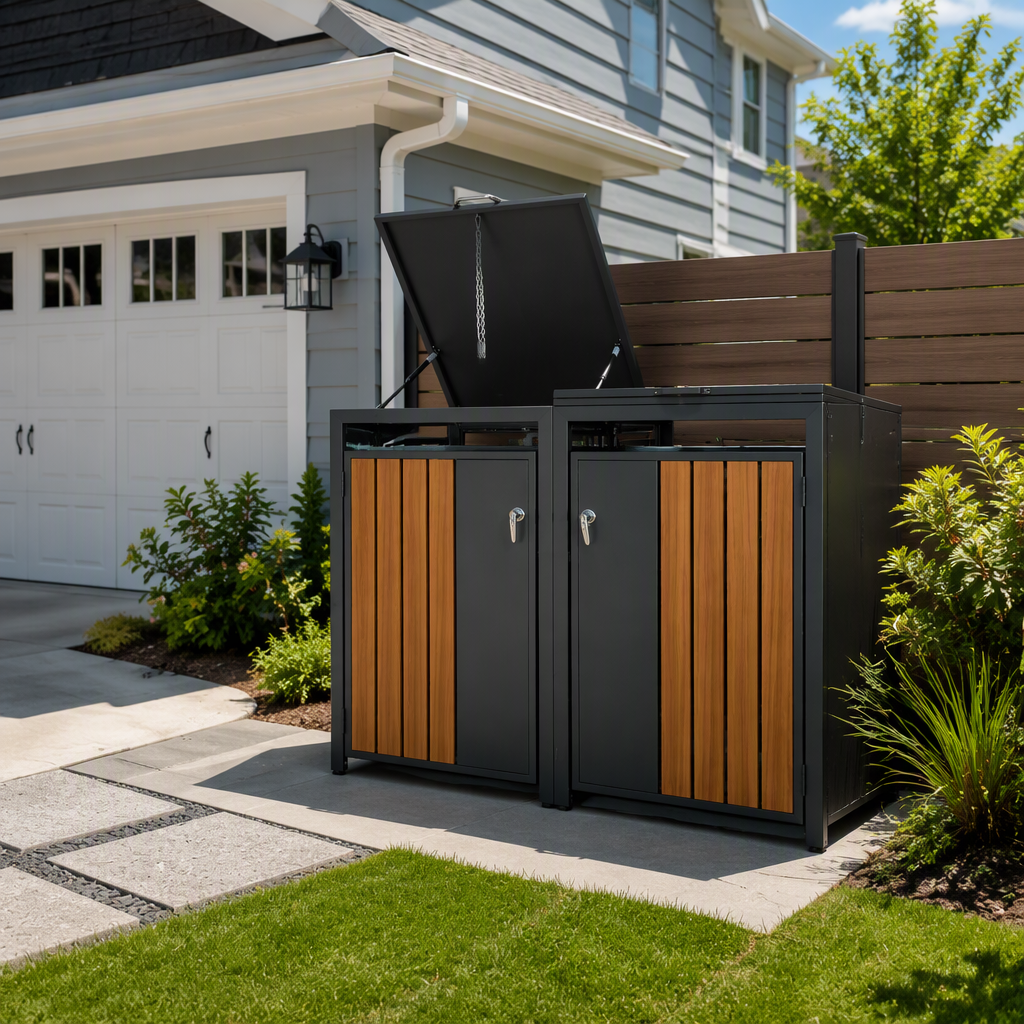
The MJ-240L Galvanized Steel Trash Bin Storage Cabinet is an outdoor waste-cart enclosure that screens and secures a 240 L bin. EPA reports that the United States generated 292.4 million short tons of municipal solid waste in 2018, or 4.9 pounds per person per day, underscoring the need for organized waste storage at homes and commercial properties.
MJ-240L galvanized steel trash bin storage cabinet with a top lid, lockable front door and wood-look panels.
MJ-240L Product Specifications at a Glance
MJ-240L product specifications combine a compact steel cabinet with access, mobility and ventilation features for outdoor waste-cart storage. The model is intended for a 240 L cart format, but buyers should verify the cart’s exact height, width, depth and lid movement before ordering because dimensions vary by waste hauler.
Item |
Confirmed specification |
Product type |
Galvanized steel trash bin storage cabinet |
Model |
MJ-240L |
Metric dimensions |
74 x 82 x 120 cm |
Approximate U.S. dimensions |
29.1 x 32.3 x 47.2 in |
Net weight |
34 kg, approximately 75 lb |
Intended bin format |
240 L, approximately 63.4 U.S. gal |
Access features |
Top lid and front door |
Security feature |
Lock |
Handling features |
Wheels and gas strut |
Airflow feature |
Ventilation openings |
Primary material |
Galvanized steel |
7 U.S. Settings Where the MJ-240L Cabinet Can Improve Waste Storage
U.S. settings for the MJ-240L range from residential side yards to managed commercial properties. Suitability depends on the local collection cart, placement surface, climate, property rules and required clearances.
1. Single-Family Homes and HOA Communities
Single-family homes can use the cabinet to screen a wheeled trash cart from patios, side yards and street-facing views. The lock can discourage casual access, while the front door allows the cart to roll in and out. Homeowners should check HOA design rules, utility easements and municipal cart-placement requirements before fixing the cabinet’s location.
2. Multifamily Apartments and Townhomes
Multifamily properties can use individual cabinets where residents store assigned carts near garages, service alleys or small yards. Property managers should preserve pedestrian circulation, emergency access and the collection crew’s working space rather than placing the cabinet in a required walkway.
3. Restaurants, Cafes and Small Food-Service Sites
Restaurants can use an outer cabinet to organize the area around a compatible waste cart, but the inner cart must still meet applicable sanitation requirements. CDC guidance recommends thick plastic or metal garbage containers with tight-fitting lids to help control rodents. The enclosure’s outer lid, door and lock do not replace a sound, tightly lidded waste container or local health-code compliance.
4. Hotels, Motels and Short-Term Rentals
Hotels can place the cabinet near maintenance yards, pool-support areas or back-of-house service zones where loose carts would be visually distracting. Operators should confirm that guests cannot enter restricted waste areas and that the installation does not obstruct accessible routes, fire lanes or service doors.
5. Offices, Clinics and Small Commercial Buildings
Offices can use the MJ-240L for ordinary nonhazardous waste generated in break rooms and daily operations. The cabinet is not presented as storage for medical, hazardous, flammable or regulated waste; those materials require appropriate containers and disposal procedures.
6. Schools, Parks and Community Facilities
Schools and community facilities can use a lockable cabinet to reduce casual access to a wheeled cart and create a more orderly service area. Facility teams should keep the unit away from playground circulation, exits and vehicle sightlines, and should establish a cleaning schedule for high-use sites.
7. Patios, Pool Areas and Outdoor Amenity Spaces
Patios and pool areas can benefit from concealed waste storage when the cabinet is placed outside splash zones and does not narrow an accessible route. The 34 kg cabinet should stand on a level, stable surface, and any movable installation should be secured against unintended rolling or displacement.
Galvanized Steel Performance: What the Material Can and Cannot Do
Galvanized steel performance begins with a zinc coating that helps protect the underlying steel. The American Galvanizers Association explains that zinc provides barrier protection and sacrificial protection, while its zinc patina corrodes more slowly than bare steel. This makes galvanized steel a practical material for many outdoor enclosures.
Galvanized steel is corrosion resistant, not corrosion proof. Actual service life depends on factors that have not yet been supplied for this model, including:
- Whether the sheet is hot-dip galvanized, continuously galvanized or electrogalvanized
- Zinc coating weight or thickness
- Base-steel thickness
- Treatment of cut edges, welds and fastener holes
- Additional paint or powder-coat system
- Coastal salt exposure, deicing salts and industrial pollutants
- Drainage, standing water and cleaning practices
- Scratches or damage that expose the base steel
For public product claims, request the coating specification and any applicable corrosion-test report before stating a salt-spray duration, warranty period or expected rust-free service life.
Lid, Door, Lock, Wheels, Gas Strut and Vents: How Each Feature Helps
Lid, door, lock, wheels, gas strut and vents address different steps in daily use. They should be evaluated as a system rather than as isolated accessories.
Feature |
Practical function |
Buyer verification point |
Top lid |
Provides upper access to the cart |
Confirm opening angle, handle location and clearance |
Front door |
Lets the wheeled cart roll in and out |
Confirm clear opening and latch operation |
Lock |
Helps control casual or unauthorized access |
Confirm lock type, key management and outdoor rating |
Wheels |
Support repositioning or handling |
Confirm wheel diameter, load rating and brake configuration |
Gas strut |
Assists lid opening and closing |
Confirm rated force, mounting hardware and replacement availability |
Ventilation openings |
Allow passive airflow through the enclosure |
Confirm opening size, rain exposure and pest-screen design if required |
The ventilation openings may help reduce trapped heat and stagnant air, but they do not eliminate odor. Odor control still depends on bagging waste, keeping the cart lid closed, removing waste on schedule, cleaning spills and allowing surfaces to dry.
MJ-240L Dimensions: How to Check Cart Compatibility
MJ-240L dimensions measure 74 x 82 x 120 cm, or approximately 29.1 x 32.3 x 47.2 inches. These are cabinet dimensions supplied for the product; they should not automatically be treated as internal clear dimensions.
Before ordering, measure the wheeled cart in three conditions:
1. Cart body with lid closed
2. Cart lid fully open
3. Cart tilted back on its wheels for removal
Allow space for handles, hinges, wheel movement and the gas-strut mechanism. Also verify whether the local hauler requires the cart to be placed outside the enclosure on collection day.
Site Placement: What U.S. Buyers Should Check Before Installation
Site placement should begin with a level, stable surface and enough working space to open both the top lid and front door. The cabinet should not block doors, meters, utility equipment, drainage paths or collection access.
For residential sites, check:
- HOA rules on visible trash containers and enclosure color
- Property-line setbacks and utility easements
- Local requirements for collection-day placement
- Wind exposure and surface drainage
- Distance from windows, air intakes and outdoor living areas
For commercial and public sites, also check:
- Required accessible-route width and door-swing clearance
- Fire-lane and emergency-exit access
- Health-department waste-storage requirements
- Janitorial workflow and collection-truck access
- Whether floor anchoring is permitted or required
Because anchoring points, wind testing and wheel-brake details have not been provided, project-specific anchoring or high-wind claims should be reviewed before permanent outdoor installation.
Maintenance: How to Protect the Cabinet and Keep the Area Clean
Maintenance for the cabinet should focus on cleanliness, drainage, moving parts and early repair of coating damage.
1. Remove leaked waste and rinse compatible surfaces with mild soap and water.
2. Keep drainage paths and ventilation openings clear.
3. Dry standing water rather than allowing it to remain at seams or the base.
4. Inspect the lock, hinges, wheels and gas strut at regular intervals.
5. Touch up exposed steel using a coating approved for galvanized surfaces.
6. Avoid harsh chemicals or abrasive tools unless the finish supplier approves them.
7. Keep the inner trash cart closed and clean; the outer cabinet is not a substitute for cart sanitation.
8 Questions U.S. Buyers Should Ask Before Ordering the MJ-240L
U.S. buyers should ask these questions before placing a residential, commercial or distributor order:
1. Is the cabinet’s 74 x 82 x 120 cm size external or internal?
2. Which 240 L cart models have been physically test-fitted?
3. Is the steel hot-dip galvanized, continuously galvanized or electrogalvanized?
4. What are the steel thickness and zinc-coating specification?
5. Are the wheels fitted with brakes, and what is their load rating?
6. What lock type and gas-strut specification are included?
7. Is an anchoring kit available for high-wind or public-area installations?
8. What written warranty, replacement-parts policy and corrosion-test documentation are available?
Frequently Asked Questions
Frequently asked questions about the MJ-240L cover cart compatibility, outdoor use, corrosion, animal access, ventilation and anchoring.
Is the MJ-240L a trash can or a trash can enclosure?
The MJ-240L is a galvanized steel trash bin storage cabinet designed to enclose a compatible 240 L wheeled cart. Waste should remain inside the appropriate inner cart rather than being placed directly into the steel cabinet.
Will every 240 L trash cart fit inside the MJ-240L?
Every 240 L cart will not necessarily have identical dimensions. Buyers should compare the cart’s body, lid, handle and wheel dimensions with the cabinet’s verified internal clearances before ordering.
Can the MJ-240L be used outdoors?
The MJ-240L uses galvanized steel, a material selected for improved corrosion resistance compared with uncoated steel. Outdoor suitability still depends on coating specification, finish quality, drainage, climate, maintenance and installation conditions.
Is the MJ-240L rustproof?
The MJ-240L should not be advertised as completely rustproof without supporting test data and warranty terms. Galvanizing helps protect steel, but exposed edges, coating damage, salt and standing moisture can increase corrosion risk.
Does the lock make the cabinet animal proof?
The lock helps control access, but animal resistance depends on door gaps, vent openings, latch design and installation. No raccoon-proof, rodent-proof or bear-resistant claim should be made without relevant testing.
Do the ventilation openings remove trash odors?
The ventilation openings provide passive airflow but do not remove odor by themselves. Closed bags, a tight inner-cart lid, prompt pickup and routine cleaning remain necessary.
Can the cabinet store medical or hazardous waste?
The cabinet is not presented as compliant storage for medical, hazardous, flammable or regulated waste. Those materials require approved containers, labeling and disposal procedures.
Does the MJ-240L need to be anchored?
MJ-240L anchoring depends on the site, wind exposure, surface, wheel and brake configuration, and local requirements. Confirm the manufacturer’s anchoring option before permanent outdoor placement.
Conclusion
The MJ-240L conclusion is straightforward: this 34 kg galvanized steel cabinet combines a top lid, front door, lock, wheels, gas strut and ventilation openings in a compact enclosure for a compatible 240 L cart. Its strongest U.S. applications are organized residential and light-commercial waste-storage areas where appearance, controlled access and serviceability matter.
Before publication or purchase, confirm internal clearances, galvanizing method, steel and zinc thickness, wheel brakes, anchoring, corrosion testing and warranty terms. These details turn a general product description into a verifiable specification for U.S. buyers.
Suggested Calls to Action
Suggested calls to action should match the buyer type and the information required for a reliable fit or project recommendation.
Homeowners:
- Send your cart dimensions and a photo of the placement area for a fit check.
Property managers:
- Share the number of units, surface type and access requirements for a project recommendation.
Distributors:
- Request packing dimensions, loading quantity, replacement-parts availability and private-label options.
Suggested Internal Links
Suggested internal links should connect the article to verified product, material, quotation and after-sales pages. Replace these descriptions with existing live URLs; do not invent links.
1. Link “galvanized steel trash bin storage cabinet” to the product page.
2. Link “coating specification” to the materials or quality-control page.
3. Link “project recommendation” to the commercial quotation page.
4. Link “replacement-parts availability” to the after-sales policy.
Recommended Image ALT Text
Recommended image ALT text should describe the visible product and feature without adding unverified performance claims.
MJ-240L galvanized steel trash bin storage cabinet for a 240 liter cart
1.Lockable outdoor metal garbage can enclosure with front door and top lid
2.MJ-240L trash bin cabinet wheels gas strut and ventilation openings
3.Galvanized steel trash can storage cabinet for U.S. residential property
4.Structured Data Recommendation
Structured data recommendations include BlogPosting schema for the article and FAQPage schema only when all eight FAQ questions and answers are visibly published. Do not add ratings, corrosion-test results, certifications or warranty claims without supporting documents.
Authoritative Sources
Authoritative sources support the article’s waste-generation, rodent-control, zinc-protection and accessibility context.
U.S. EPA: National Overview, Facts and Figures on Materials, Wastes and Recycling
1.CDC: How to Seal Up to Prevent Rodents
2.American Galvanizers Association: Zinc Coatings for Steel Corrosion Protection
3.U.S. Department of Justice: 2010 ADA Standards for Accessible Design
4.Publication Checklist
The publication checklist identifies product facts that still require manufacturer confirmation before the page goes live.
- Confirm whether 74 x 82 x 120 cm are external dimensions.
- Confirm verified internal clearances and compatible cart models.
- Confirm galvanizing method, steel thickness and zinc-coating specification.
- Confirm wheel brakes and load rating.
- Confirm lock and gas-strut specifications.
- Confirm available anchoring kit and wind guidance.
- Confirm warranty, corrosion testing and replacement-parts policy.
- Add real product photos and the final brand name.
- Add live internal links before publication.
Table of Contents
- MJ-240L Product Specifications at a Glance
-
7 U.S. Settings Where the MJ-240L Cabinet Can Improve Waste Storage
- 1. Single-Family Homes and HOA Communities
- 2. Multifamily Apartments and Townhomes
- 3. Restaurants, Cafes and Small Food-Service Sites
- 4. Hotels, Motels and Short-Term Rentals
- 5. Offices, Clinics and Small Commercial Buildings
- 6. Schools, Parks and Community Facilities
- 7. Patios, Pool Areas and Outdoor Amenity Spaces
- Galvanized Steel Performance: What the Material Can and Cannot Do
- Lid, Door, Lock, Wheels, Gas Strut and Vents: How Each Feature Helps
- MJ-240L Dimensions: How to Check Cart Compatibility
- Site Placement: What U.S. Buyers Should Check Before Installation
- Maintenance: How to Protect the Cabinet and Keep the Area Clean
- 8 Questions U.S. Buyers Should Ask Before Ordering the MJ-240L
-
Frequently Asked Questions
- Is the MJ-240L a trash can or a trash can enclosure?
- Will every 240 L trash cart fit inside the MJ-240L?
- Can the MJ-240L be used outdoors?
- Is the MJ-240L rustproof?
- Does the lock make the cabinet animal proof?
- Do the ventilation openings remove trash odors?
- Can the cabinet store medical or hazardous waste?
- Does the MJ-240L need to be anchored?
- Conclusion
- Suggested Calls to Action
- Suggested Internal Links
- Recommended Image ALT Text
- Authoritative Sources